Bow Street police office
Bow Street police office, situated in the Covent Garden district of London, functions in Oliver Twist as the primary site of summary urban justice—a place where the poor and accused are processed with arbitrary speed and where the novel's harshest critique of legal institutions is concentrated. It is here that Oliver, arrested for a theft he did not commit, confronts the bullying magistrate Mr. Fang, and here that the machinery of the law is shown to operate not as a protector of the innocent but as an extension of the class prejudices that have hounded Oliver since birth.
Location and Institutional Character
The office is described as a "very notorious metropolitan police office," located within the district where the alleged crime occurred. Oliver is led there through a back way—beneath a low archway, up a dirty court—entering a small paved yard where a stout man with a bunch of keys receives him. The building contains a stone cell where prisoners are locked up before their hearing; this cell is "most intolerably dirty," having been tenanted by six drunken people since the previous Saturday night. The narrator pointedly compares these holding cells to the dungeons of Newgate, declaring that the latter, occupied by convicted felons under sentence of death, are "palaces" by comparison. This spatial hierarchy—from the filthy cell to the magistrate's office—establishes the Bow Street office as a place where the poor are degraded before they are even charged.
The Fang Hearing: A Travesty of Justice
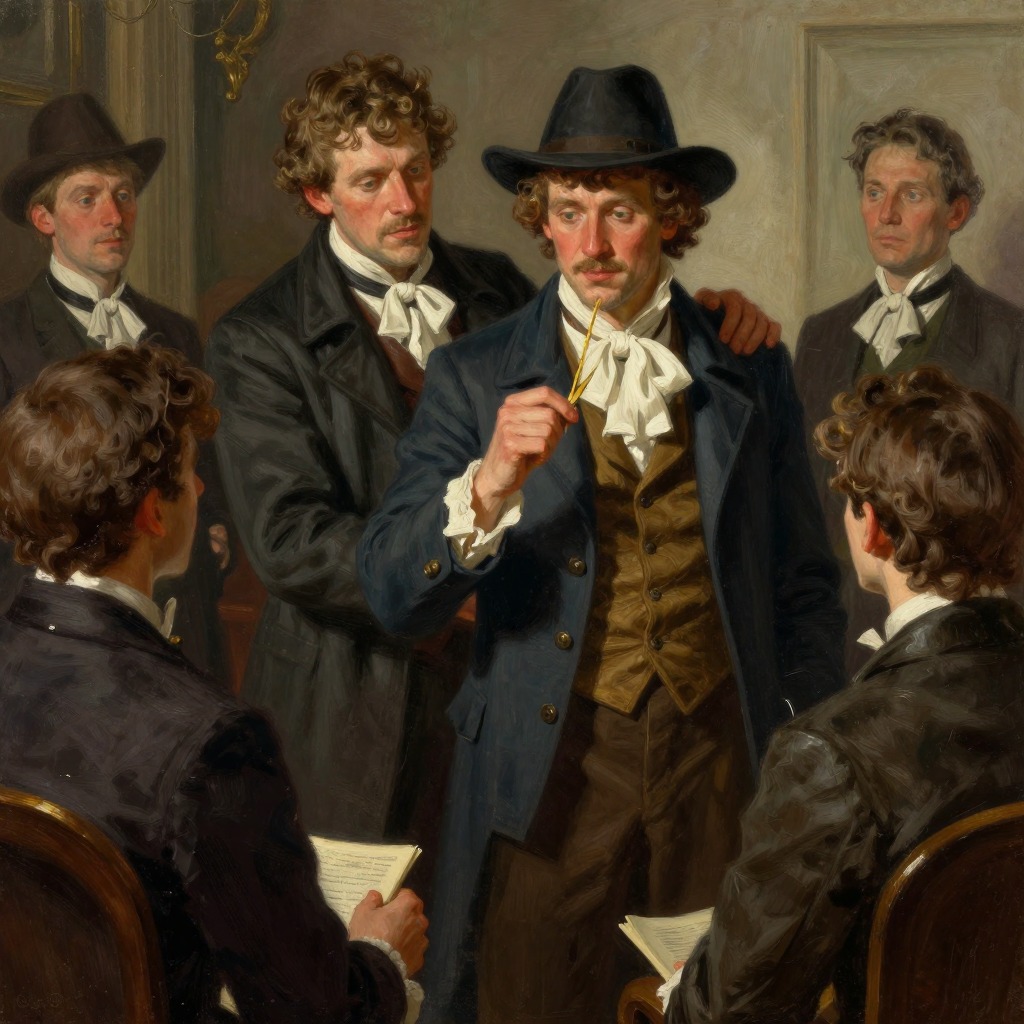
The presiding magistrate, Mr. Fang, is a lean, long-backed, stiff-necked man with a flushed face and a bullying manner. He is reading a newspaper article that commends him for a recent decision when Mr. Brownlow, the prosecutor, is ushered in. Fang immediately treats Brownlow with contempt, tossing his card aside and demanding, "Who is this fellow?" When Brownlow protests, Fang threatens to have him turned out of the office. The magistrate refuses to let Brownlow state his case in an orderly fashion, repeatedly interrupting him and swearing the policeman before hearing the prosecutor's account. Throughout the hearing, Fang displays a peremptory and insulting demeanor, treating the respectable Mr. Brownlow as though he were the accused. When Oliver, pale and terrified, cannot answer questions, the officer hazards a guess that his name is Tom White, and Fang accepts this fabrication without verification. The magistrate's conduct exemplifies the arbitrary power that the novel attributes to petty officialdom.
Oliver's Collapse and the Book-Stall Keeper's Intervention
As the hearing proceeds, Oliver grows increasingly ill, his tongue failing him and the room seeming to turn round and round. He murmurs a feeble prayer for a draught of water, but Fang dismisses this as shamming and declares, "Let him lie there; he'll soon be tired of that." Oliver falls to the floor in a fainting fit, and no one in the office dares to assist him. Fang summarily commits him for three months' hard labour. At this critical moment, the book-stall keeper who witnessed the actual theft rushes into the office, breathless, and demands to be sworn. He testifies that he saw two other boys commit the robbery and that Oliver was "perfectly amazed and stupified by it." Fang, with ill grace, discharges Oliver but turns his sarcasm on Mr. Brownlow, accusing him of having obtained the book he was reading "under very suspicious and disreputable circumstances." The magistrate's parting words are a warning to Brownlow to consider himself fortunate not to be prosecuted.
Aftermath and Narrative Significance
Oliver is carried out insensible and laid on the pavement in the yard, where Mr. Brownlow, his anger vanishing, calls for a coach and takes the boy to his own home in Pentonville. The Bow Street office thus serves as the threshold between Oliver's life of criminal association and his rescue by Brownlow—but it is a threshold crossed only through the accidental intervention of a witness and the magistrate's capricious decision, not through any genuine justice. The office also appears later in the novel as the place where the Dodger is tried and committed for pickpocketing, and where Fagin is ultimately condemned to death. The advertisement for Oliver that Mr. Bumble sees in the newspaper originates from inquiries made through Bow Street, and the officers Blathers and Duff, who investigate the Chertsey burglary, are Bow Street runners. The office thus functions as a recurring institutional node, connecting the novel's various threads of crime, punishment, and the failure of legal protection for the poor.